
Gold Bars: Sizes, Fineness, Marks and What Good Delivery Means
Some links may be affiliate links. If you buy through them, we may earn a commission at no extra cost to you.
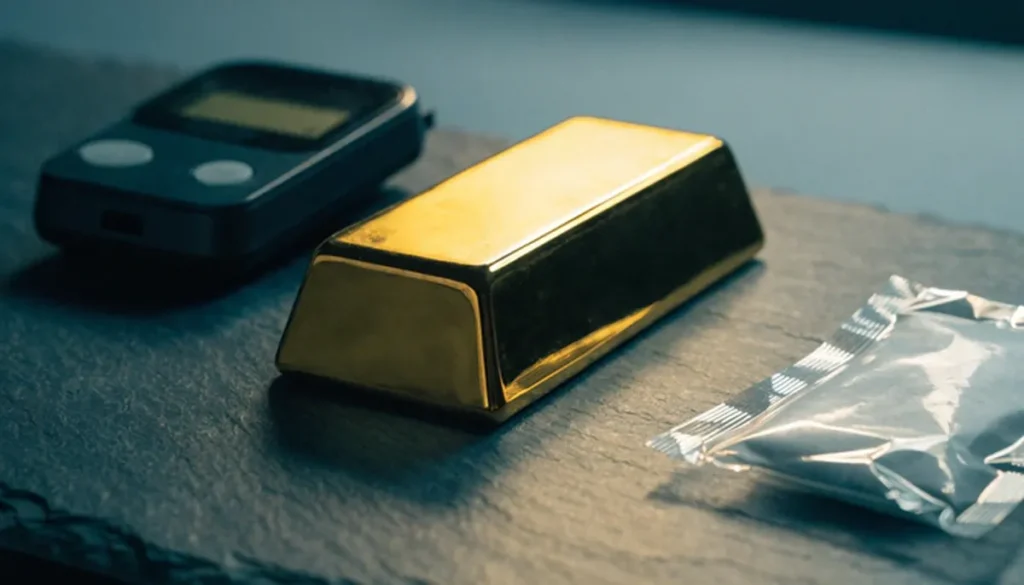
The London Bullion Market Association sets the “Minimum gold content: 350 fine troy ounces” and the “Maximum gold content: 430 fine troy ounces” for a Good Delivery gold bar, the standard wholesale bar.
At the CFTC and FINRA bulletin’s example price of $2,000 an ounce, a bar of about 400 ounces holds roughly $800,000 of gold, which is our arithmetic. A one-ounce bar from a retail shelf is a different product under different rules.
That is the first thing to know about gold bars: the term encompasses several products that meet different standards.
This article walks through the London bar, the exchange bars, the small retail bars and the marks on them, then covers the paperwork and the scams that regulators describe. It also says where the sources stop, because on counterfeit testing they do.
The Wholesale Bar and What Good Delivery Means
The LBMA’s Good Delivery Rules describe the bar traded in the London wholesale market. “Only gold and silver bars that meet our Good Delivery standards are acceptable” in settling a London contract, and the LBMA describes the bar as one “of approximately 400 troy ounces for gold.” The technical specification gives the numbers.
| Feature | LBMA specification |
|---|---|
| Gold content | 350 to 430 fine troy ounces, about 10.9 to 13.4 kilograms |
| Minimum fineness | 995.0 parts per thousand |
| Top surface | 250 mm +/- 40 mm long, 70 mm +/- 15 mm wide |
| Height | 35 mm +/- 10 mm |
| Shape | Ingot, with a trapezoidal cross-section |
Fineness explains why the table counts “fine” ounces. A fineness of 995.0 means 995 parts of every thousand are gold, so a bar needs a gross weight a little above its gold content. Our arithmetic: a bar holding 400 fine ounces at 995 fineness weighs about 402 ounces in total.
One point surprises many buyers. A Good Delivery bar is not a brand, and the LBMA’s list names companies. It publishes “lists of gold and silver refiners who are accredited by the LBMA to supply gold and silver bars.”
A bar counts as Good Delivery when a listed refiner makes it to the rules. The LBMA also states that “No other refined gold or silver products produced by accredited refiners fall within the scope of the Good Delivery Lists.” Kilo bars and smaller bars are therefore outside the lists, even when the same refiner makes them.
What Is Stamped on a Bar
The LBMA’s marking rules read like a checklist. A Good Delivery bar carries the “stamp of the Refiner,” the fineness “to four significant figures,” a serial number “which must not comprise more than 11 digits or characters,” and, “Since January 2019, Refiners must include the month and year of production on their bar as MMYY.”
The characters for fineness, date, and serial number must be at least 12 millimeters tall, and “Laser engraving is not permitted under any circumstances.” A bar that fails the rules must be stamped “NGD (meaning Non-Good Delivery).”
The LBMA also describes security features that “establish the identity and verify the authenticity of a gold bar,” and says they can serve the wholesale bar or “wider Retail markets (kilo bars, smaller bars etc.).”
It states that “the likelihood of a fraudulent or counterfeit LGDB entering the wholesale London Market is extremely low.” That is a market body describing its own system, not a test you can run.
The sources cited in this article provide no official method for checking a bar at home. Magnets, density checks, and acid tests are not covered by any regulatory source, so this article does not endorse any of them.
The Exchange Bars: 100 Ounces and One Kilo
Two bar sizes also come from the futures exchange. In a February 2024 filing with the CFTC, COMEX describes its gold contract as “one hundred (100) troy ounces of gold with a weight tolerance of 5% either higher or lower,” and says it “shall assay to a minimum of 995 fineness and must be a brand approved by the Exchange.”
Its kilo contract asks for a “one kilogram bar (32.15 troy ounces)” that “shall assay to a minimum .9999 fineness.” The filing is a redline of the rules, so check the current exchange rulebook before relying on a figure.
These contracts matter to a retail buyer for two reasons. The tax code ties its IRA exception to futures rules, as described below. And the IRS ties its dealer reporting to them.
What a Retail Bar Costs
The bulletin explains the pricing frame in four sentences. “The spot price is quoted in dollars per troy ounce.” “A dealer will always sell metal above the spot price and buy it back below the spot price.” Spreads differ widely: “Some fraudulent dealers have charged spreads of more than 300 percent while other dealers may charge less than 20 percent.”
And the buyer’s protection is paper: “Ask for all fees, costs, commissions, and agreed retail price in writing BEFORE signing a sales agreement.” The bulletin lists “What’s the dealer’s buy-back price?” among the questions to ask.
A worked example, with invented prices. A kilo bar holds 32.15 troy ounces. At a $2,000 spot price, which is the bulletin’s example figure, its metal is worth $64,300. Suppose a dealer quotes $66,000 and a buyback of $63,500. You would pay $1,700 over the metal, or about 2.6 percent, and the buyback sits $800 below it.
The dealer’s entire margin ranges from $66,000 to $63,500, a gap of $2,500, or about 3.8 percent of the price you paid. The bulletin does not compare bar premiums with coin premiums, and no other primary source read for this article does, so no claim about which costs less appears here.
Paperwork on a Bar Purchase
The IRS tells dealers when to report a gold sale on Form 1099-B. Metal in a form the CFTC “has not approved trading by regulated futures contract (RFC) is not reportable,” and even for approved forms “the sale is not reportable if the quantity, by weight or by number of items, is less than the minimum required quantity.”
Sales to one customer in 24 hours “must be aggregated and treated as a single sale.” The regulation itself names no bar sizes. It allows exceptions “So designated by the Internal Revenue Service in a revenue ruling or revenue procedure.” Whether a particular bar is reportable depends on those quantities, and that is the dealer’s duty, so ask the dealer rather than assume.
Cash is a separate rule. The IRS says that if you “receive more than $10,000 in cash in a single transaction or in related transactions, you must file Form 8300,” and “You must file Form 8300 within 15 days after the date the cash transaction occurred.”
A dealer in precious metals must also run an anti-money laundering program once it meets the regulation’s tests for more than $50,000 in covered goods bought and more than $50,000 in covered goods sold.
Gold Bars and an IRA
The IRA exception for bars is a fineness test. The tax code allows gold “bullion of a fineness equal to or exceeding the minimum fineness that a contract market” requires for delivery against a regulated futures contract, if the trustee has physical possession.
The exchange minimum quoted above is 995 for the 100-ounce bar and .9999 for the kilo bar. A home bar does not qualify, and the CFTC says, “Only certain bullion can be kept in an IRA.” Confirm any bar with the custodian before buying.
The Scam That Uses Bars
Gold bars are involved in a courier scam that the FBI warned about in January 2024: “Criminals then arrange for couriers to meet the victims in person to pick up the cash or precious metals,” with “aggregated losses of over $55 million” from May to December 2023.
The FBI’s rule is short: “The US Government and legitimate businesses will never request you purchase gold or other precious metals.” An FTC alert from July 2025 warns that a request to buy gold bars and hand them to someone is a scam, and tells people not to give bars to a courier.
Common Questions
Is my one-ounce or kilo bar a Good Delivery bar?
No. The LBMA says no other refined products from accredited refiners fall within the scope of the Good Delivery Lists, and the standard bar holds 350 to 430 fine ounces.
What should be stamped on a gold bar?
For a Good Delivery bar: the refiner’s stamp, the fineness, a serial number of up to 11 characters, and the month and year of production. Smaller bars follow their maker’s own rules.
How can I test a bar at home?
No regulator source read for this article describes a home test. The best check is to buy from a dealer you’ve verified and keep the paperwork.
Will the purchase be reported?
That depends on the form and the quantity under the dealer’s Form 1099-B duty. Cash over $10,000 triggers Form 8300 within 15 days.
A Rule Before You Buy
Find out which standard the bar follows, read its marks against the dealer’s invoice, get the price and the buyback in writing, and hand a bar to no one who calls you first.