
Gold and Silver Premiums and Spreads: What the CFTC Says to Check
Some links may be affiliate links. If you buy through them, we may earn a commission at no extra cost to you.
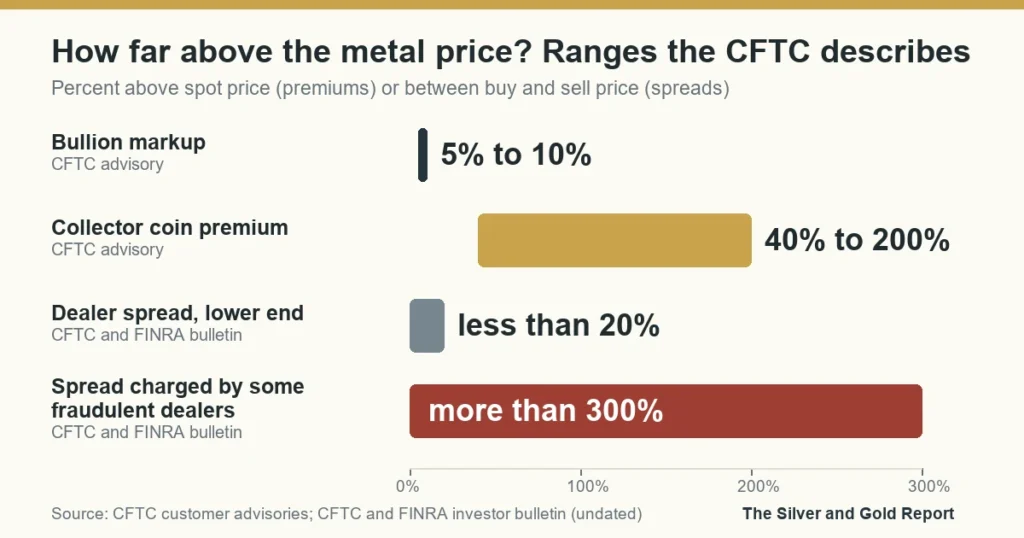
The Commodity Futures Trading Commission describes the markup on bullion as “a markup or ‘premium’ of between 5 percent and 10 percent,” and says premiums on collector coins “can range from 40 percent to 200 percent above the spot price.”
Those two ranges are the whole reason this topic matters. A buyer who doesn’t check the premium can’t tell a fair price from an expensive one, and the CFTC has brought cases against dealers over how they priced and described these sales.
What Spot, Premium and Spread Mean
The joint CFTC and FINRA investor bulletin on buying physical metals defines the spot price as “the cash price for immediate delivery of physical metal,” quoted “in dollars per troy ounce.” One widely used benchmark is the LBMA Gold Price, which the LBMA says is set “twice daily (at 10:30 and 15:00 London UK time) in US dollars per troy ounce” and administered independently by ICE Benchmark Administration.
A coin or bar costs more than the metal inside it, and the difference is the premium. The bulletin gives an example: “If the current spot price is $2,000, for example, a half-ounce coin would be worth $1,000, plus the dealer’s markup or ‘premium.'” The CFTC’s formula on its advisory page is sales price minus spot price, divided by spot price, times 100, which equals the premium percentage.
The spread is a different number. The bulletin says “A dealer will always sell metal above the spot price and buy it back below the spot price.” The gap between the dealer’s selling price and its buying price is the spread, and the bulletin adds that “Each dealer sets its own spread, so it pays to shop around.”
A Worked Example
These numbers are made up, and they use the bulletin’s $2,000 spot price. Three dealers quote a one-ounce coin on the same afternoon.
| Dealer | Sells at | Buys back at | Premium over spot | Spread |
|---|---|---|---|---|
| A | $2,140 | $1,980 | 7.0% | $160 (8.0% of spot) |
| B | $2,110 | $1,990 | 5.5% | $120 (6.0% of spot) |
| C | $2,060 | $1,900 | 3.0% | $160 (8.0% of spot) |
Dealer C looks cheapest, with a premium of only 3 percent. But its buyback price is $100 below spot, so a customer who bought and sold the same day would lose $160, exactly what Dealer A’s customer would lose. Dealer B has the narrowest spread, so it costs the least to buy and sell back, even though its premium isn’t the lowest.
The break-even works the same way. Say you buy from Dealer A at $2,140, and the dealer keeps buying back at 1 percent below spot. To sell at your purchase price, spot must rise to about $2,162, a gain of roughly 8.1 percent, before you’re even.
Bullion and Collector Coins
The bulletin separates two kinds of coins. “Bullion coins or ingots share a common investment-grade purity and weight,” while “‘Numismatic’ means the coins are rare or collectible.” The 40 to 200 percent range applies to the second kind.
It also calls out a middle category: “‘Semi-numismatic’ is a made-up industry term that really has no special meaning.” These coins are “sold as collectible but typically are not rare and carry no additional value,” and “If anything, they are likely less liquid” than bullion, which means harder to sell. Its warning is blunt: “If someone tries to charge you more for collectible or ‘semi-numismatic’ coins, it’s likely a scam.”
Costs Outside the Price
The price on the quote isn’t the whole bill. The bulletin lists “storage, insurance, administrative fees, and possibly additional taxes and penalties if you take money from a qualified retirement account.” For metals in a self-directed IRA, it says “IRA custodians also charge for their services, and self-directed IRA fees are typically higher than directed-IRA fees.”
One more detail matters for IRA owners: the custodian’s statement “shows the ‘melt’ value of the metals.” Melt value is the value of the metal itself, so the number on your statement will typically sit below what you paid once the premium and spread are counted.
Why Spreads Hide in Plain Sight
The bulletin says “Retail metal dealers are not regulated at the federal level.” It gives the range of what the market looks like: “Some fraudulent dealers have charged spreads of more than 300 percent while others dealers may charge less than 20 percent.” The gap between those two ends is enormous, and a buyer who only looks at the headline price may never see it.
When Premiums Eat the Account
The CFTC advisory on gold and silver retirement schemes gives one example: a company “charged nearly $150,000 in commissions and fees to a customer who rolled over a $300,000 retirement account into a gold IRA.” It adds that “customers have reported losing half of their investment to fees.” The bulletin describes victims of gold or silver IRA fraud who “had one-third to one-half of their savings drained by fraudsters’ markups, fees, and commissions.”
Enforcement continues. In September 2022, the CFTC ordered Goldline and A-Mark Precious Metals to disgorge $627,801.78 and pay a $450,000 civil monetary penalty. The order covered fraud, illegal retail commodity transactions and registration violations.
The two advisory pages quoted here carry no date. The retirement-scheme advisory mentions the CARES Act, which suggests it was written in 2020, so treat its percentage ranges as the CFTC’s description of the market at that time, not a quote from today’s price sheets.
Common Questions
Why does a dealer buy back below spot?
That’s how a dealer earns money on the way out. The CFTC bulletin says a dealer “will always sell metal above the spot price and buy it back below the spot price.”
What should a dealer put in writing?
The bulletin says to “Ask for all fees, costs, commissions, and agreed retail price in writing BEFORE signing a sales agreement or turning over any money.” If they aren’t available in writing, “that is a red flag.”
What if the dealer offers free metal?
The bulletin suggests you “Ask how the company earns its profit, especially if it appears to be giving away precious metal or offering other big freebies.”
Is a 5 to 10 percent bullion markup normal?
It’s the CFTC’s description of bullion markups in an undated advisory that appears to date from 2020. Premiums change with the metal, the product and the market, so run the formula on today’s actual quote.
A Rule Before You Buy
Ask every dealer for the spot price they’re using, their selling price and their buyback price for the same item, then run the CFTC formula yourself. If a dealer won’t give you the buyback price, treat that as an answer.