
Gold Capital Gains Tax: Where the 28% Rate Comes From
Some links may be affiliate links. If you buy through them, we may earn a commission at no extra cost to you.

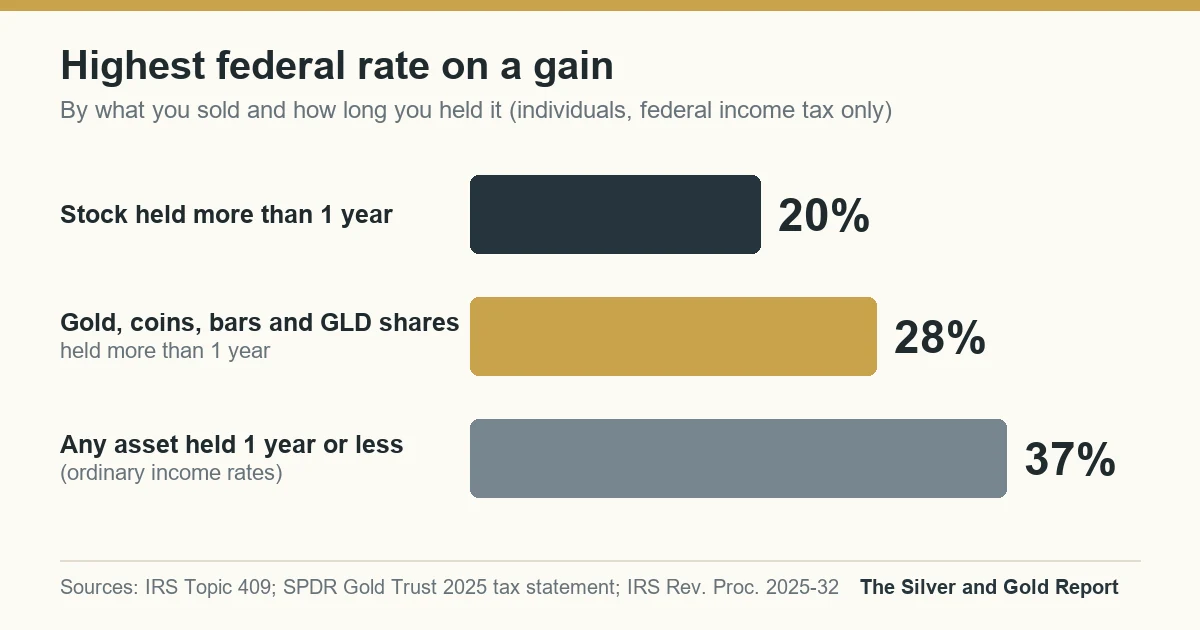
The IRS taxes a long-term gain from selling gold at a maximum rate of 28%, while a stock held just as long tops out at 20%, a gap of 8 percentage points on every dollar of profit.
IRS Topic 409 says net capital gains from selling collectibles, “such as coins or art,” are taxed at a maximum 28% rate. The sponsor of the SPDR Gold Trust (GLD) tells shareholders in its 2025 tax statement that gains on gold bullion and on GLD shares held more than one year are taxed at a maximum of 28%, “rather than the 20% rate applicable to most other long-term capital gains.”
The Internal Revenue Code reaches 28% in two steps. The second step hides a surprise for anyone who holds a coin that an IRA is allowed to own.
How the Code Turns Gold Into a Collectible
Section 408(m)(2) defines a collectible as any work of art, rug, antique, metal, gem, stamp or coin, plus alcoholic beverages and any other tangible property the Treasury specifies. Gold bars land in the metal slot. Gold coins land in the coin slot.
Section 1(h)(5)(A) then says collectibles gain is gain from selling a collectible “as defined in section 408(m) without regard to paragraph (3) thereof,” held for more than one year. The 28 percent figure itself sits in section 1(h)(1)(F).
The IRA Exception Ends at the Account Door
Paragraph (3) of section 408(m) carves coins and bullion out of the collectible definition for one purpose: an IRA can hold them without the purchase counting as a distribution of what it cost. The carve-out covers gold coins described in four paragraphs of section 5112 of title 31 (the law behind U.S. Mint coins), silver coins described in section 5112(e), platinum coins described in section 5112(k), any coin issued under a state’s laws, and gold, silver, platinum or palladium bullion that meets the minimum fineness a regulated futures contract market requires, held by the IRA’s trustee.
The rate rule reads the definition without regard to paragraph (3). So a coin that qualifies for an IRA is still a collectible when you sell it outside one after holding it more than a year, and the 28% ceiling applies to the profit.
Gold ETFs Follow the Same Rule
GLD is a grantor trust, so the trust pays no federal income tax and its shareholders are treated as if they owned a pro rata share of the gold directly, according to the 2025 statement. The Code has a look-through for this setup. Under section 1(h)(5)(B), gain from selling an interest in a partnership, S corporation or trust that is attributable to unrealized appreciation in collectibles counts as gain from selling a collectible. The same statement says gains on assets held one year or less are generally taxed at the rates that apply to ordinary income.
The 2026 Thresholds Next to the 28% Ceiling
For tax year 2026, Revenue Procedure 2025-32 sets the highest taxable income at which long-term gains on most assets are taxed at 0% and at 15%. Above the 15% ceiling, the rate is 20%.
| Filing status | 0% rate up to | 15% rate up to | Gold and coins |
|---|---|---|---|
| Single | $49,450 | $545,500 | 28% maximum |
| Married filing jointly | $98,900 | $613,700 | 28% maximum |
| Head of household | $66,200 | $579,600 | 28% maximum |
The Math at Maximum Rates
Say you bought gold for $10,000, held it three years, and sold it for $17,500. The $7,500 gain is long-term. At the 28% maximum, the federal tax is $2,100. The same $7,500 gain on a stock at 20% costs $1,500, and at 15% it costs $1,125.
That is an illustration at the maximum rates, before state tax. Your own bill depends on your taxable income.
What Dealers Report to the IRS
The 2026 Instructions for Form 1099-B say a sale of gold, silver, platinum or palladium in any form the Commodity Futures Trading Commission has not approved for trading by regulated futures contract is not reportable. Even in an approved form, a sale is not reportable if the quantity is below the minimum needed to satisfy an approved contract. The IRS example is a single gold coin, which needs no Form 1099-B if every approved contract for gold coins calls for delivery of at least 25 coins.
Sales for one customer within a 24-hour period are added together. The exception also drops away if the broker knows or has reason to know that a customer is making sales to avoid information reporting.
Those instructions govern what a broker files. You report the sale yourself on Form 8949, summarized on Schedule D, and the Schedule D instructions include a 28% Rate Gain Worksheet for line 18.
When You Lose Money
A net capital loss lowers your other income by the lesser of $3,000 ($1,500 if you’re married filing separately) or the net loss. Anything beyond that carries forward to later years, per IRS Topic 409.
Write down the purchase date and the cost of every coin and bar on the day you buy it. The date decides whether a gain is taxed at ordinary rates or capped at 28%, and the cost sets the size of the gain you report.
Everything above covers U.S. federal income tax for individuals; state and local rules differ. Rules and figures checked November 16, 2026 against the IRS Topic 409 page, 26 U.S.C. 408 and 26 U.S.C. 1, the SPDR Gold Trust 2025 Grantor Trust Tax Reporting Statement, IRS Revenue Procedure 2025-32, the Instructions for Form 1099-B and the Instructions for Schedule D.