
Where to Buy Bullion: Local Shops, Mints, Online Dealers, Banks
Some links may be affiliate links. If you buy through them, we may earn a commission at no extra cost to you.
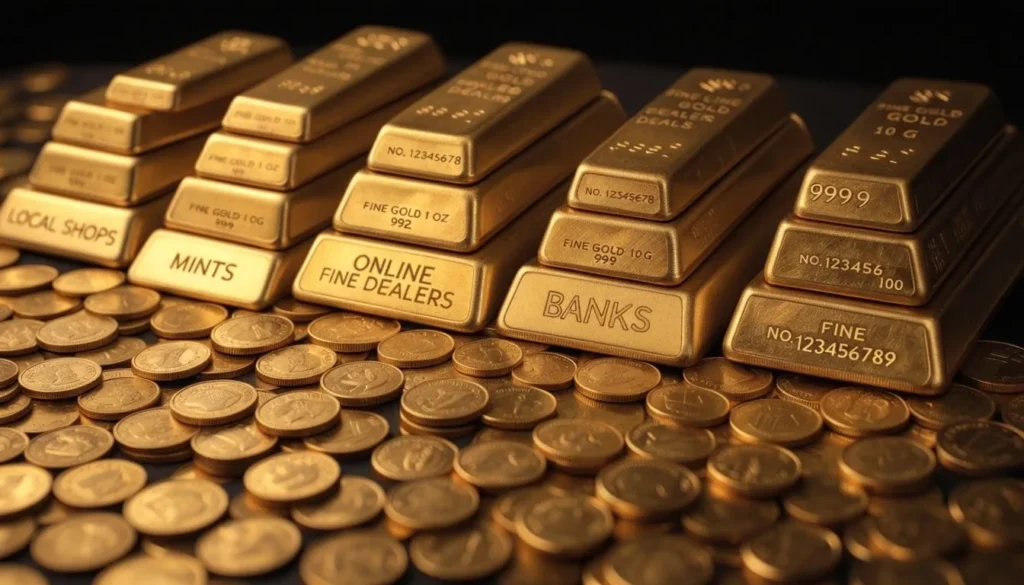
Buyers of physical gold and silver can approach a local coin shop, a mint, an online dealer, or a bank, and the metal itself is the same in each case. What decides the choice is verification: retail metal dealers are not regulated at the federal level in the United States, so the buyer must confirm who is on the other end of the sale.
The material reviewed here covers local dealers, mints, and online sellers with real substance. It says almost nothing about banks as a place for ordinary buyers to purchase metal, and this comparison says so rather than guessing.
At a glance
| Local coin shops and dealers | Mints | Online dealers | Banks | |
|---|---|---|---|---|
| In-person access | Yes, visiting in person is advised | One national mint has two visitor locations | Not applicable; buyer must confirm a physical address | Not stated |
| Main trust check | Established reputation, recommendations, complaint history with local and state bodies | A mint’s list of registered dealers; the mint itself as seller | Verify address, years in business, owners’ complaint history | Not stated |
| Pricing note | Each dealer sets its own spread; compare quotes with the spot | Premium covers production and transportation | The same spot-price comparison applies | Not stated |
| Federal regulation of retail sellers | None at the federal level | Not stated | None at the federal level | Not stated |
| Main warning | Pushy pitches and pop-up sellers | Not stated | Unsolicited emails, social media posts, pop-up pitches | Not stated |
How to judge any seller
A national mint that publishes buying guidance for the public says three things matter most: price, trust, and accessibility. Price means shopping around, requesting competitive quotes, and comparing each quote to the current spot price.
Trust means choosing an established dealer, asking for recommendations, and visiting in person if possible. Accessibility means understanding how a dealer’s buying and selling process works, with the mint’s advice being that “the easier, the better.”

Spot price is the cash price for immediate delivery of physical metal. It is quoted in dollars per troy ounce and is easy to find through financial news or quote providers. U.S. regulators give a simple example: if spot gold were $2,000, a half-ounce coin would be worth $1,000 before the dealer’s markup, known as the premium.
No seller offers metal at spot. A dealer sells above the spot price and buys back below it, and the gap between those two prices is the dealer’s spread. Each dealer sets its own, which is why comparison pays. U.S. regulators say some fraudulent dealers have charged spreads above 300 percent, while other dealers may charge less than 20 percent.
What the price really includes
The quoted price is only part of the cost. A mint’s buyer guidance notes that purchases may incur a fee, typically a percentage of the amount invested, plus a premium to compensate the provider for producing and transporting the product. Selling and storing physical metal bring their own costs.
The form of the metal also changes the premium. Coins are typically more affordable than bars because they weigh less, but they tend to carry higher premiums. Fractional coins also tend to cost more per ounce than larger ones.
Bars come with lower premiums, which is why financial institutions, investment funds, and corporations buying large quantities often choose them. Coins, on the other hand, can be easier to sell when an owner wants to liquidate part of a holding.
The U.S. regulators’ advice on fees is firm. Get every fee, commission, and the agreed retail price in writing before signing or paying. Understand what return would be needed to break even, because the larger the spread and other costs, the further the spot price must rise before a buyer profits.
Local coin shops and dealers
A local dealer is described by the mint as one of the easiest ways to buy physical coins and bars. U.S. regulators give similar advice: start in your own community with well-established dealers. A shop with a street address can be visited, its reputation can be asked about locally, and its quotes can be compared in person.
The drawback is that “local” does not mean “vetted”. Because retail dealers are not federally regulated, regulators suggest checking local consumer organizations and the state attorney general or securities regulator for a history of complaints.
Other checks include the Better Business Bureau to see whether a dealer is rated or accredited and the searchable database of coin sellers that the U.S. Mint maintains. This route suits buyers who value face-to-face dealing and are willing to do a few minutes of background research. Regulators also warn against pop-up dealers who sell at public events or ask to come to your home.
Mints
A mint sits at the source of the product, and the Royal Canadian Mint’s guidance is the clearest example in the material. It has two locations visitors can visit, and publishes a list of registered dealers, so a buyer can find an approved seller near home. Its guidance still describes the local dealer as one of the easiest routes for most buyers.
The premium is also explained plainly there: it pays for the production and transportation of bullion products. The material does not say whether buying directly from a mint costs less than buying from a dealer, so no price advantage should be assumed. A mint suits buyers who want a recognized issue or who want a vetted list of dealers rather than building one from scratch. Distance may limit the direct option, since the mint named in the material has only two visitor locations.
Online dealers
Online selling is not ruled out by regulators, but it comes with extra homework. For anyone who shops online, U.S. regulators advise verifying the dealer’s physical address and how long it has been operating. They also advise searching the names of owners and salespeople for prior complaints or criminal allegations.
The warnings are sharper here because many scam tactics travel through digital channels. Regulators describe fraudulent dealers who infiltrate social media groups, target advertising at follower lists, send spam email, and even steal images of religious leaders, pundits, and celebrities to fake endorsements.
Their advice is never to respond to unsolicited emails, social media posts, or pop-up pitches. An online dealer suits a buyer who initiates the search, finds the seller on his or her own terms,s and can document the seller’s history before sending money. It does not suit one who responds to an unprompted offer.
Banks
The material does not describe banks as a retail source of physical bullion, so no claim about their prices, products,s or protections can be made here. What it does say about banks concerns the wholesale side of the market. Twice a day, the London Bullion Market Association sets a fixed price for gold, and banks, mines,s and other large market participants use it as a benchmark. The association uses a similar process for silver and platinum.
That role is useful context because it shows that the benchmark prices used in the market are the same ones a retail buyer should compare against. It does not indicate whether a particular bank will sell coins or bars to the public. A reader who prefers to deal with a bank should ask the bank directly what it offers and what it charges before comparing it with the other three channels.
Why verification comes first
The regulatory warnings explain why trust ranks so high. The U.S. Commodity Futures Trading Commission (CFTC) says that over the past decade, it has brought numerous cases against dealers that collectively sold more than $500 million of overpriced metals. In September 2020, the CFTC and 30 state authorities filed a joint civil action in the U.S. District Court for the Northern District of Texas. It targeted a $185 million scheme that allegedly sold fraudulently overpriced gold and silver bullion to elderly people nationwide.
Retirement accounts are a particular concern. The CFTC and the Financial Industry Regulatory Authority (FINRA) say fraudulent dealers push rollovers into gold IRAs because that is where many people hold most of their savings.
These are usually self-directed individual retirement accounts that the account holder manages and that offer fewer protections than a standard account. In one cited case, a customer rolled over a $300,000 IRA, and the dealer allegedly took $150,000 in fees and commissions. In some cases, victims had one-third to one-half of their savings drained by markups, fees, and commissions.
“These frauds can be particularly damaging to individuals near retirement and retirees who could lose much of their retirement savings and find themselves unable to return to work to support themselves,” said Melanie Devoe, director of the CFTC’s Office of Customer Education and Outreach.
Regulators also ask buyers to check whether a salesperson is registered. Anyone who suggests what to buy, how much, or when may be giving advice and may be required to register with the CFTC, the Securities and Exchange Commission, FINRA, or a state regulator. FINRA’s free BrokerCheck tool can be used to research the backgrounds of financial professionals and firms. If financing is involved and the buyer will not take physical delivery, regulators suggest checking whether the seller is registered with the National Futures Association.
Which one to choose
- Choose a local coin shop or dealer if you want to meet the seller, inspect the product, and compare quotes in person. Check complaint records with local and state bodies first.
- Choose a mint or a dealer from a mint’s registered list if you want a recognized source or a ready-made short list. Confirm prices against spot like any other quote.
- Choose an online dealer if you start the search yourself, can verify a physical address and operating history, and can obtain every fee in writing. Walk away from any seller who contacts you first.
- Ask a bank directly if you prefer to buy through one. The material here does not establish that banks sell bullion to the public or on what terms.
- Avoid any seller, whatever the channel, who pressures you to act now, promises large profits, implies limited supply, or pushes a retirement rollover.
- Consider an exchange-traded fund instead if storage, transport, and insurance are the obstacles. The mint’s guidance notes that these funds offer the liquidity of stock investments without the logistics of holding physical metal.
Precious metal prices can fall and are sometimes quite volatile. Regulators recommend considering how metals fit into an overall strategy and talking with an investment professional before buying.