
Junk Silver: What 90% Silver Coins Contain and How to Price Them
Some links may be affiliate links. If you buy through them, we may earn a commission at no extra cost to you.
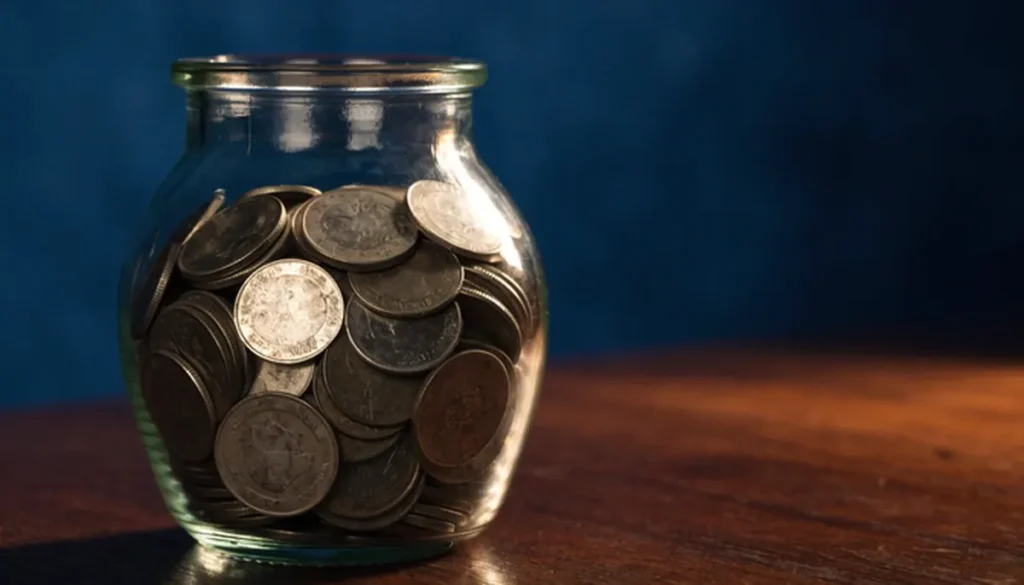
Ten dimes, four quarters, or two half dollars: each pile has a face value of one dollar, and if the coins are pre-1965 silver, each pile contains the same amount of pure silver, about 22.5 grams.
That is roughly 0.7234 troy ounces, according to our calculations based on the figures below. The coin’s size and design affect the pile’s weight, but they do not change the silver inside it.
That is why people who buy “junk silver” count it by face value. The name refers to worn, circulating coins that sell mainly for their metal.
This article shows where the 90 percent figure comes from, why 1964 is the dividing line, how to determine what a bag holds, and what the IRS and regulators say about buying, selling, and holding it.
Where the federal sources do not answer a question, we say so.
Where the 90 Percent Comes From
The Coinage Act of 1873 set the standard for U.S. silver coins. It says “of one thousand parts by weight nine hundred shall be of pure metal and one hundred of alloy,” and “the alloy of the silver coins shall be of copper.”
That is 90 percent silver and 10 percent copper. The same Act fixed the half dollar at “twelve grams (grams) and one-half of a gram,” and set the quarter at one-half of the half dollar’s weight and the dime at one-fifth of the half dollar’s weight.
Our arithmetic from those ratios gives 12.5 grams for the half dollar, 6.25 grams for the quarter, and 2.5 grams for the dime, with 11.25 grams, 5.625 grams, and 2.25 grams of pure silver in them.
| Coin (pre-1965) | Weight, our arithmetic | Pure silver at 90% | Coins per $1 | Silver per $1 face |
|---|---|---|---|---|
| Dime | 2.5 g | 2.25 g | 10 | 22.5 g |
| Quarter | 6.25 g | 5.625 g | 4 | 22.5 g |
| Half dollar | 12.5 g | 11.25 g | 2 | 22.5 g |
One caution about the table: the Act gives ratios for the dime and quarter and does not print their weights in grams. A U.S. Code from 1925 prints the half dollar at “one hundred and ninety-two and nine-tenths grains,” which matches 12.5 grams by our arithmetic, but the U.S. Mint’s own pages were not readable for this article, so the dime and quarter weights rest on the 1873 ratios.
To convert, NIST gives the troy ounce as 31.10348 grams. At 22.5 grams per dollar, that is 0.7234 troy ounces per dollar of new coins. Many sellers quote a lower figure, commonly 0.715, and this article found no primary source for why. Worn coins hold a little less silver than new ones.
Why 1964 Is the Line
Public Law 89-81, dated July 23, 1965, is the Coinage Act of 1965. It authorized dimes and quarters as clad coins: “Any coin minted under authority of this section shall be a clad coin.” The cladding was “an alloy of 75 per centum copper and 25 per centum nickel” over a copper core, with no silver in the quarter.
The Act let the Mint continue making the old coins for a time, saying, “Half dollars, quarter dollars, and dimes may be minted from 900 fine coin silver only until such date” the law fixed.
The half dollar kept some silver. The Act describes a coin whose “whole coin weighs 11.5 grams and contains 4,6 grams of silver,” where the comma is a misprint for 4.6 in the scanned law.
That is 40 percent silver by our arithmetic. A dollar of 40 percent half dollars therefore holds only about 9.2 grams, or 0.2958 troy ounce, against 0.7234 for the earlier coins.
Do not pay 90 percent of the price for a 40 percent coin. The Act also barred “standard silver dollars” for five years, and this article did not verify the make-up of any later dollar coin, so it leaves them out.
What Is a Fair Price
The CFTC and FINRA bulletin outlines the method, and it applies to any silver. “The spot price is quoted in dollars per troy ounce.” The buyer should “Multiply the weight of the metals you are considering by the current spot price” and compare the result with the quote. “A dealer will always sell metal above the spot price and buy it back below the spot price.”
The bulletin warns that “Some fraudulent dealers have charged spreads of more than 300 percent,” and that “Retail metal dealers are not regulated at the federal level.”
An example with invented numbers shows the arithmetic. Suppose spot silver is $30 an ounce. A dollar of face value of 90 percent coins holds 0.7234 ounce, so its metal is worth $21.70. A dealer quotes $24 for that dollar of face value, which is $2.30 above the metal, or about 10.6 percent.
If the dealer were to buy the same coins back at $20.50, the gap between your price and the buyback price is $3.50, or about 14.6 percent of what you paid. Ask for the buyback in writing, and ask whether the dealer counts the silver by weight or by face value, since the two can differ if the coins are worn.
The bulletin also warns about two words. “Numismatic” means the coins are rare or collectible. “Semi-numismatic” is “a made-up industry term that really has no special meaning.”
A bag of common worn dimes is neither rare nor collectible. If a seller describes it that way, you are being asked to pay for a story. No primary source read for this article gives a standard premium for junk silver, so the article gives none.
Taxes, Reporting and an IRA
The IRS treats coins and metals as collectibles when it sets tax rates. IRS Topic 409 says “Net capital gains from selling collectibles (such as coins or art) are taxed at a maximum 28% rate.”
Publication 550 defines collectibles gain to include a “metal (such as gold, silver, and platinum bullion), gem, stamp, coin, or alcoholic beverage held more than 1 year,” and lists “collectibles gain 28%” as the top rate.
Neither page uses the phrase “junk silver,” so this article does not claim that the IRS uses it. The rate is a maximum, and the actual tax depends on your income, so check it for your own return.
Dealer reporting is the second question. The Form 1099-B instructions say a sale of a precious metal “in any form for which the Commodity Futures Trading Commission (CFTC) has not approved trading by regulated futures contract” is not reportable, and that even for approved forms “the sale is not reportable if the quantity, by weight or by number of items, is less than the minimum required quantity.”
Sales to one customer in 24 hours “must be aggregated.” The regulation, 26 CFR 1.6045-1, has no coin-by-coin list and no face-value amount for 90 percent coins. A figure that circulates on dealer pages was not found in any primary source, so it does not appear here. Ask the dealer what it files, and note that the dealer, not the buyer, files.
An IRA is stricter. The tax code lists “any metal or gem” and “any stamp or coin” as collectibles, and an IRA that buys one is treated as taking a distribution.
Its coin exception names certain gold coins, “a silver coin described in section 5112(e) of title 31,” platinum coins, and state-issued coins. Pre-1965 dimes and quarters are not on that list, and 90 percent silver is below the .999 purity of the listed silver coin, so our reading is that they fall outside it.
The bulletin says “Only certain bullion can be kept in an IRA.” Ask your custodian in writing before buying anything for an IRA.
Common Questions
How much silver is in a dollar of junk silver?
About 22.5 grams, or 0.7234 troy ounce, for new 90 percent coins, by our arithmetic. Worn coins hold a little less.
Why 1964?
The Coinage Act of 1965 made dimes and quarters copper-nickel clad and cut the half dollar to 40 percent silver. A dollar of the 40 percent half dollars holds about 0.2958 troy ounce.
How do I know I am paying a fair price?
Multiply the silver weight by the spot price, compare it to the quote, and request the buyback in writing. The gap between the two is your cost.
Can I hold junk silver in an IRA, and how is a sale taxed?
By our reading, 90 percent coins are outside the IRA coin exception. Outside an IRA, the IRS taxes gains on coins and silver bullion held more than a year at a maximum rate of 28 percent.
A Rule Before You Buy
Count the silver in ounces, price it at spot, ask for the buyback in writing, and walk away from any bag sold with a story about rarity.