
Home Safes for Gold and Silver: What the UL Ratings Mean and Do Not Mean
Some links may be affiliate links. If you buy through them, we may earn a commission at no extra cost to you.
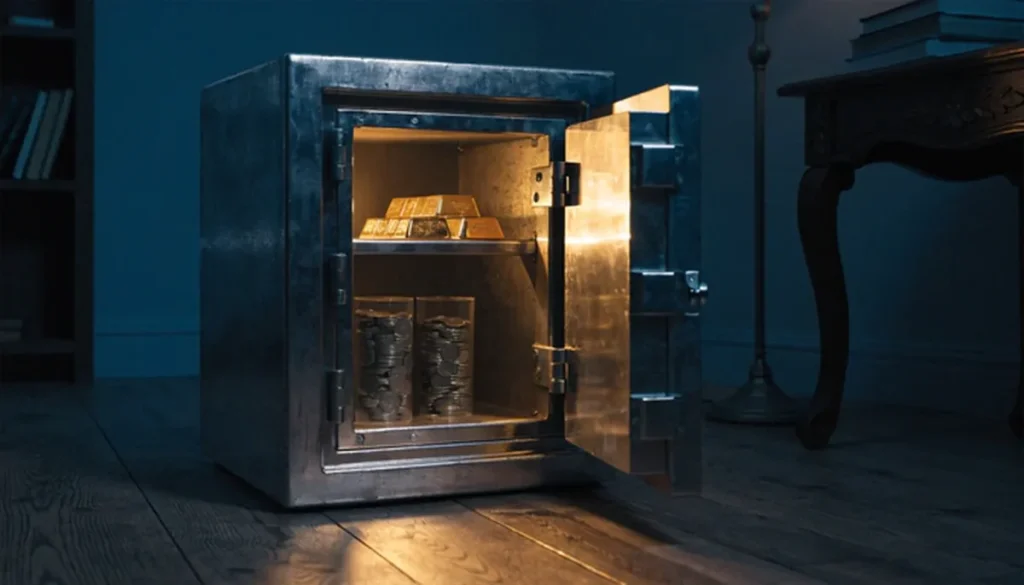
“An estimated 3.7 million household burglaries occurred each year on average from 2003 to 2007,” according to the Bureau of Justice Statistics, and in “40% of unlawful entries to unoccupied residences, offenders gained access through an unlocked door or window.”
Most of those burglars never met a safe. The ones who did were looking at a box that a standards lab had rated for a specific kind of attack.
If you keep gold or silver at home, the safe is only one part of the answer. This article explains what Underwriters Laboratories ratings do and do not say, why a fire rating is different, what your insurance covers for metal in a safe, and why an IRA changes the whole question.
How Burglars Get In
The Justice Department’s statistics bureau studied household burglaries using its National Crime Survey. Its report, from September 2010, says “Damaging or removing a door was the most common type of entry in forcible and attempted forcible entry burglaries.”
In about 28% of burglaries, “a household member was present during the burglary,” and a household member was more likely to be present during a nighttime burglary, at 61%.
Empty-home burglaries leaned toward the daytime, with 43% between 6 am and 6 pm compared to 26% from 6 pm to 6 am.
The same report says 30% of households burglarized while no one was home “had stolen items valued at more than $1,000.” A more recent survey report put the rate of burglary or trespassing at 14.6 per 1,000 households in 2022, down from 21.1 per 1,000 households in 2018.
Those are survey estimates for the country, and they describe burglary in general, not the risk at your address. The lesson for a metals owner is practical. The door, the lock, and a visible stash decide more outcomes than the safe does, and a safe is the last layer, not the first.
What the UL 687 Ratings Mean
Underwriters Laboratories publishes UL 687, the standard for burglary-resistant safes. Its scope covers “combination locked burglary-resistant safes,” and UL’s store page shows it was published July 19, 2011, and last revised July 1, 2025. The classes are named in the scope list. A TL class is tool-resistant, and a TRTL class is “Torch- and Tool-Resistant.” The top class adds explosives and is named “Torch-, Explosive-, and Tool-Resistant Safe – Class TXTL-60X6.”
| Class | Where the test attacks |
|---|---|
| TL-15, TL-30, TRTL-30 | The door and front face |
| TL-15X6, TL-30X6, TRTL-15X6, TRTL-30X6, TRTL-60X6, TXTL-60X6 | The door and body |
The free scope text on UL’s page lists the classes and where the test attacks, and nothing more. The details of the tests, including the working time and the tools, sit in the paid text of the standard, which this article does not reproduce.
The Canadian listing agency’s 2014 directory reads the numbers in plain terms. It says “Class TL-15 – at least 15 minute protection” and “Class TL-30 – at least 30 minute protection.”
That is the Canadian listing, a sibling of the American one, so use it as a guide to what the numbers mean and not as UL’s own wording. The same directory states that, in its TRTL-30X6 category, the safes “weigh at least 750 lbs.”
Sellers also use the term residential security container. UL’s own page ties that term to a different standard, UL 1037, and describes attack levels such as a “Five-minute attack using common hand tools by one technician,” then a ten-minute attack by two technicians with more aggressive tools. Do not equate that entry-level category with the TL classes. Ask the seller to name the standard and the class on the safe’s label.
A Fire Rating Is Not a Burglary Rating
Many home safes advertise a fire rating, which comes from a different standard. UL 72 covers the “fire-resistance classification of record protection equipment,” and its edition 17 was published January 27, 2026.
It says its tests are “not intended to determine acceptability for use after fire exposure,” and that the exposures “may not be representative of all fire conditions.” The standard also says the burglary resistance of a record container’s lock “is not within the scope of these requirements.” A fire rating therefore says nothing about theft.
The classes are written for records. UL 72 describes a Class 350 for paper records and a Class 150 for paper and nonpaper records. Gold and silver do not burn, so the question for a metals owner is a different one: whether the safe will survive and still open.
UL told consumers in 2008 that a one-hour rating means a safe can withstand 1,300-degree Fahrenheit heat for an hour. That is an old press release, not the current standard, so treat it as a rough guide.
What Insurance Pays for Metal in a Safe
A safe does not change the cap on the policy. A standard industry contents form hosted by the Oklahoma Insurance Department sets “$200 on money, bank notes, bullion, gold other than goldware, silver other than silverware,” and adds that the special limit “for each category shown below is the total limit for each loss for all property in that category.”
The older 1991 homeowners form hosted by the Nevada Division of Insurance shows the same $200 category. The New York Department of Financial Services lists the same typical limit and advises coin collectors to consider “insuring them separately by endorsement with a higher limit of coverage.”
The Insurance Information Institute says a floater requires that “the items covered must be professionally appraised.” Its pages speak of jewelry and silverware and do not mention bars or coins, and this article found no state source stating that a safe or its rating affects how a claim is paid or earns a discount.
Limits vary by form edition and by insurer, so read your own declarations page. Our companion article on insuring gold and silver covers the options.
IRA Metal Cannot Go in the Home Safe
The IRS answers the question directly in its IRA questions page. Asked whether IRA bullion can be stored at home, it says bullion qualifies only “provided it is in the physical possession of a bank or an IRS-approved nonbank trustee,” and it says the same holds if an IRA-owned LLC buys the bullion.
The statute says the exception applies “if such bullion is in the physical possession of a trustee.” Publication 590-A says the amount an IRA invests in a collectible “is considered distributed to you in the year invested.”
A safe in your closet is therefore a place for metal you own outside an IRA, not for the metal in a gold IRA.
Weight, Anchoring and Placement
The Canadian directory says lighter listed tool-resistant safes, those “weighing less than 340 kg,” come with anchors and anchoring instructions. 340 kilograms is about 750 pounds.
The practical point is that a small safe is a box someone can carry out, and a bolt through the floor changes what a burglar has to do. We could find no primary source on how long it takes a burglar to open a given safe, so any claim to that effect is the seller’s.
A worked example puts the pieces together. The numbers are invented. A buyer keeps $12,000 of gold and silver in a TL-15 safe and has a policy with a $200 bullion limit.
The safe raises the work a burglar must do, but it does not raise the payout, so the buyer still has to decide whether to add an endorsement. If the same buyer had put the metal in a safe with only a fire rating, UL’s own words say the rating does not address theft at all.
Common Questions
Will my homeowners policy replace my gold and silver?
Usually only a small amount. Standard forms cap bullion, gold and silver at $200 per loss category, and extra cover comes from an endorsement or an appraised floater.
What do TL-15, TL-30 and TRTL-30 mean?
TL means tool-resistant and TR means torch-resistant. These three classes are tested on the door and front face, and the X6 versions on the door and body. The Canadian listing reads the numbers as at least 15 or 30 minutes of protection.
Is a fire rating the same as a burglary rating?
No. UL 72 covers fire resistance, and the burglary resistance of a record container’s lock is outside its scope.
Can I keep my IRA gold in a safe at home?
No. The IRS says the bullion must be in the physical possession of a bank or an IRS-approved nonbank trustee, and an IRA-owned LLC does not change that.
A Rule Before You Buy a Safe
Read the label for the standard and the class, not the marketing, then compare your insurance limit with the value of what goes inside. Buy the safe for the standard on its label, and insure the difference.