
Goldbacks: What They Are, What the Company Claims and What We Could Not Confirm
Some links may be affiliate links. If you buy through them, we may earn a commission at no extra cost to you.
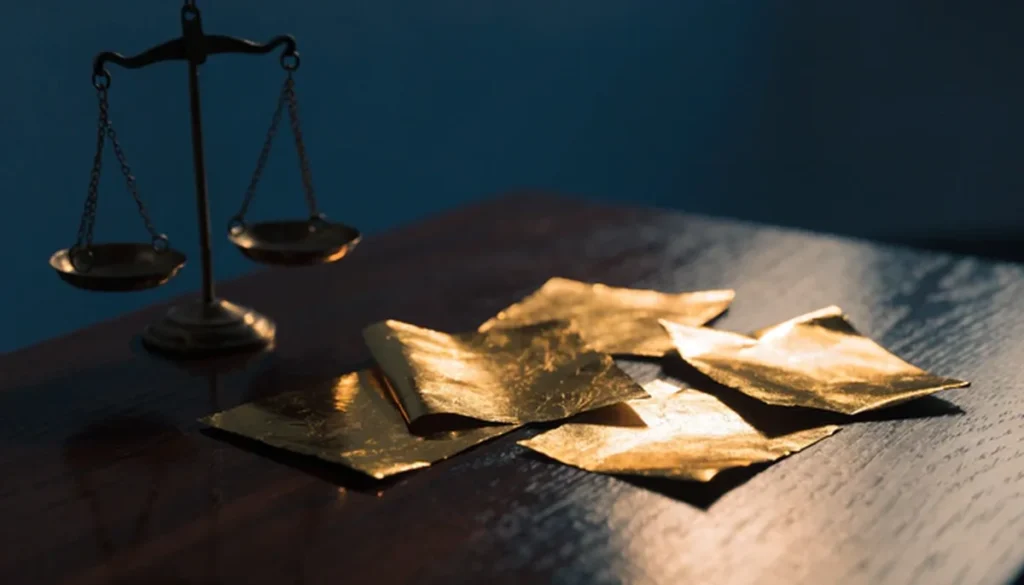
One Goldback, the company says, holds one thousandth of a troy ounce of 24-karat gold, and any 1,000 of them add up to one full ounce. That claim comes from the company that makes them, Goldback Inc., and it is the starting point for everything below.
The company is not a regulator, and what it says about itself is a claim, not a finding.
This article separates three things: what Goldback Inc. says about its product, what federal law and the IRS say about money and gold in general, and what we could not confirm.
The third list is longer than usual, because the most important question, how Utah law treats Goldbacks, could not be checked.
What the Company Says a Goldback Is
According to Goldback Inc., the product is 24-karat gold reduced to as little as one four-thousandth of an ounce and layered between two polymer sheets. It comes in eight denominations.
The company lists the 1 Goldback at 1/1000 troy ounce of gold, the 50 Goldback at 1/20 ounce, and the smallest note, the one quarter, at 1/4000 ounce.
It says the Goldback was launched in 2019 and lists series for 10 states: Utah, Nevada, Wyoming, New Hampshire, South Dakota, Florida, Oklahoma, Arizona, Idaho, and California, including a 2026 Utah series.
On value, the company says a Goldback’s value is tied to the average exchange rate it publishes on its website, updated daily at 10 AM Mountain time.
It says Goldbacks carry a premium over spot gold because producing them is labor-intensive, and that Goldback Inc. is a wholesaler that does not control the prices set by independent retailers. It also says it tries to avoid states with sales tax on gold. We repeat these as the company’s statements. We did not verify them, and we do not repeat the company’s return figures or its merchant count as fact.
Legal Tender: What Federal Law Says
Federal law defines legal tender in Title 31. United States coins and currency are legal tender for all debts, public charges, taxes and dues, and foreign gold or silver coins are not legal tender for debts.
Nothing in that text mentions Goldbacks, and the company does not claim federal legal-tender status.
Its own FAQ states that Goldbacks are recognized as an exchangeable currency only in jurisdictions where local or state law authorizes them.
In other areas, it says they are often used as a barter tool or as a gold product with intrinsic value, and that any Goldback can be used anywhere as long as both parties agree.
That leaves the state question. Utah has a statute on gold and silver as money, and Goldbacks are marketed in Utah. We could not read that statute: the Utah Legislature’s website refused every request or timed out.
Search summaries suggested the law defines the money it covers as gold or silver coin issued by the United States, which, if accurate, might not describe a private note. That is an inference from unverified summaries, and we do not state it as fact.
Read the Utah Code yourself, or ask a Utah attorney, before you rely on a Goldback as legal tender there. We also read two federal criminal statutes on making or passing metal coins as money and on tokens that imitate coins, and we draw no conclusion from them about Goldbacks.
The company says its product is completely legal. That is a company claim, not a legal finding.
Taxes: What the IRS Says, and What It Does Not
No IRS page we read mentions Goldbacks, so the tax class of a Goldback is not confirmed by any source. The IRS does speak about gold and silver in general. Publication 550 says they are capital assets unless held for sale by a dealer, and that any gain or loss from their sale or trade is generally a capital gain or loss.
The same publication lists metals such as gold, silver, and platinum bullion and coins as collectibles when held for more than a year, and
Topic 409 says net capital gains from collectibles are taxed at a maximum rate of 28 percent. Gains on assets held one year or less are short-term and are taxed as ordinary income at graduated rates.
Spending is a separate question. The IRS barter rule requires that, in the year you receive them, you include in gross income the fair market value of goods or services you receive through bartering. That describes the person who receives property or services.
Whether spending a Goldback counts as a sale of gold that triggers a gain or loss is not answered by any IRS text we read; our reading is the combination, not an IRS statement. The company itself tells users to consult a tax professional. If you spend or sell Goldbacks, ask one.
The Utah State Tax Commission has a page on a credit for gold and silver coin sales. We could only read it through a summarizing tool, so we treat it as unconfirmed.
It describes a credit for gains on U.S. government-issued coins, which, if the summary is accurate, would not clearly apply to a private product. We also found no Utah source on sales tax for gold or for Goldbacks.
Price: Premiums and the Spread
The company says Goldbacks carry a premium over spot. The CFTC and FINRA bulletin on buying metals describes how that works for any physical metal. Spot is the price for immediate delivery of the raw metal, and a dealer always sells above it and buys back below it.
The bulletin says each dealer sets its own spread, that spreads vary from under 20 percent at some dealers to over 300 percent in fraud cases, and that the greater the spread and other costs, the more spot has to rise before you profit.
Retail metal dealers are not regulated at the federal level. The bulletin is about gold and silver bullion and does not mention Goldbacks, but its steps apply: ask for all fees and the price in writing before you sign, and ask what you would receive if you had to sell back tomorrow.
An example with invented numbers shows why the premium matters. If a retailer sells a Goldback at 10 percent over its gold value and would buy it back at 3 percent below, a round trip would cost about 13 percent, and spot gold would have to rise by that much before you break even.
The actual figures vary by seller, so you should get both prices in writing.
Common Questions
Are Goldbacks federal legal tender?
Federal law defines legal tender as United States coins and currency. Goldback Inc. says its notes are recognized as currency only where local or state law allows it.
Are Goldbacks legal tender in Utah?
We could not verify the Utah statute, so we cannot say. Read the Utah Code or ask a Utah attorney.
How is the gain taxed?
The IRS does not address Goldbacks in the pages we read. For gold and silver bullion and coins in general, it applies a 28 percent maximum rate to long-term collectibles gains.
What does a Goldback cost over its gold?
The company says a premium applies and that retailers set their own prices. Ask each seller for the price and the buyback price in writing.
A Rule for Goldbacks
Treat a Goldback as a small amount of gold sold at a premium, not as guaranteed money. Check your state’s laws, get the price and buyback in writing, and ask a tax professional how a purchase, sale, or payment is treated for you.